Woodland baby-room decorating guide
How to Plan a Calm Woodland Nursery Gallery Wall
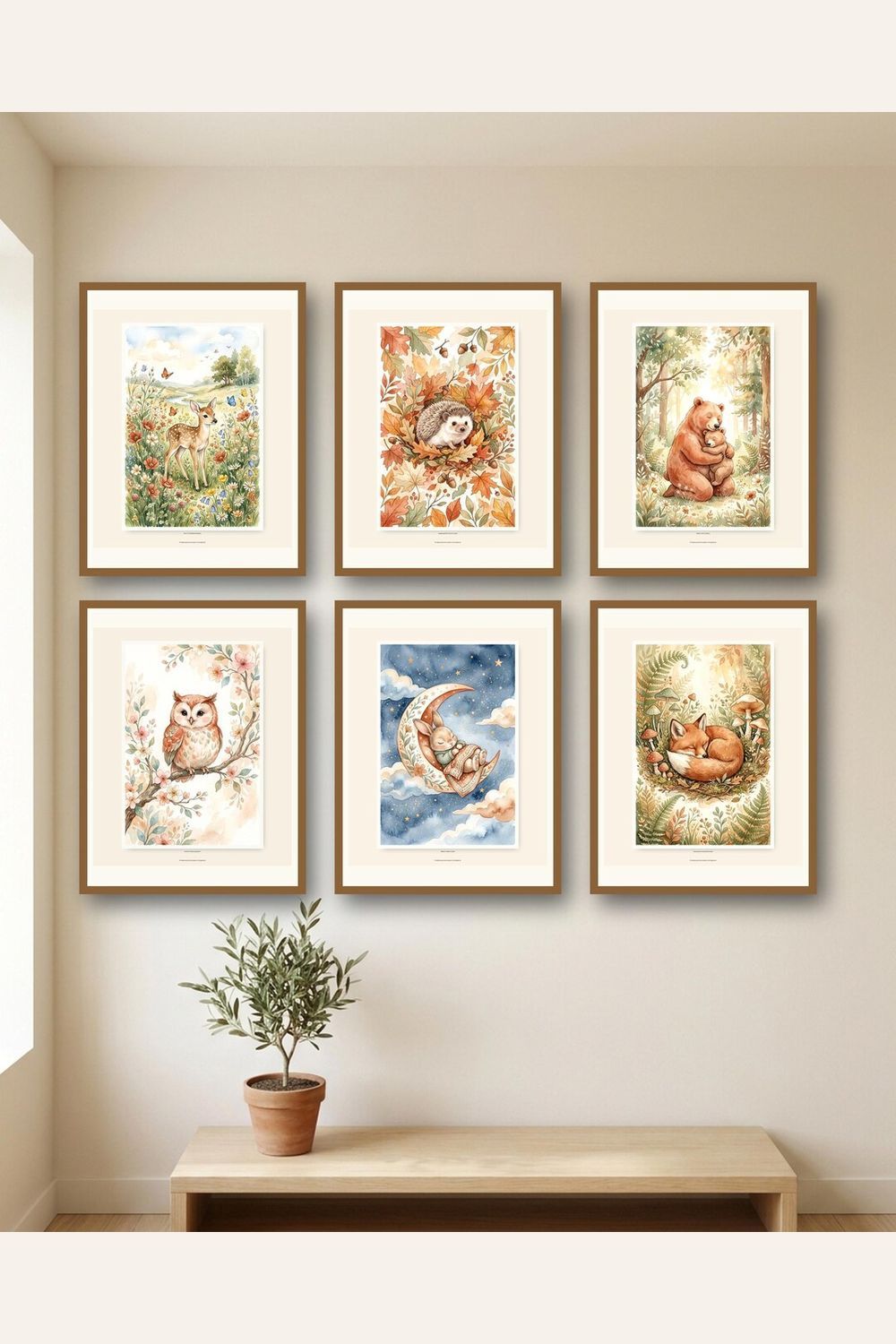
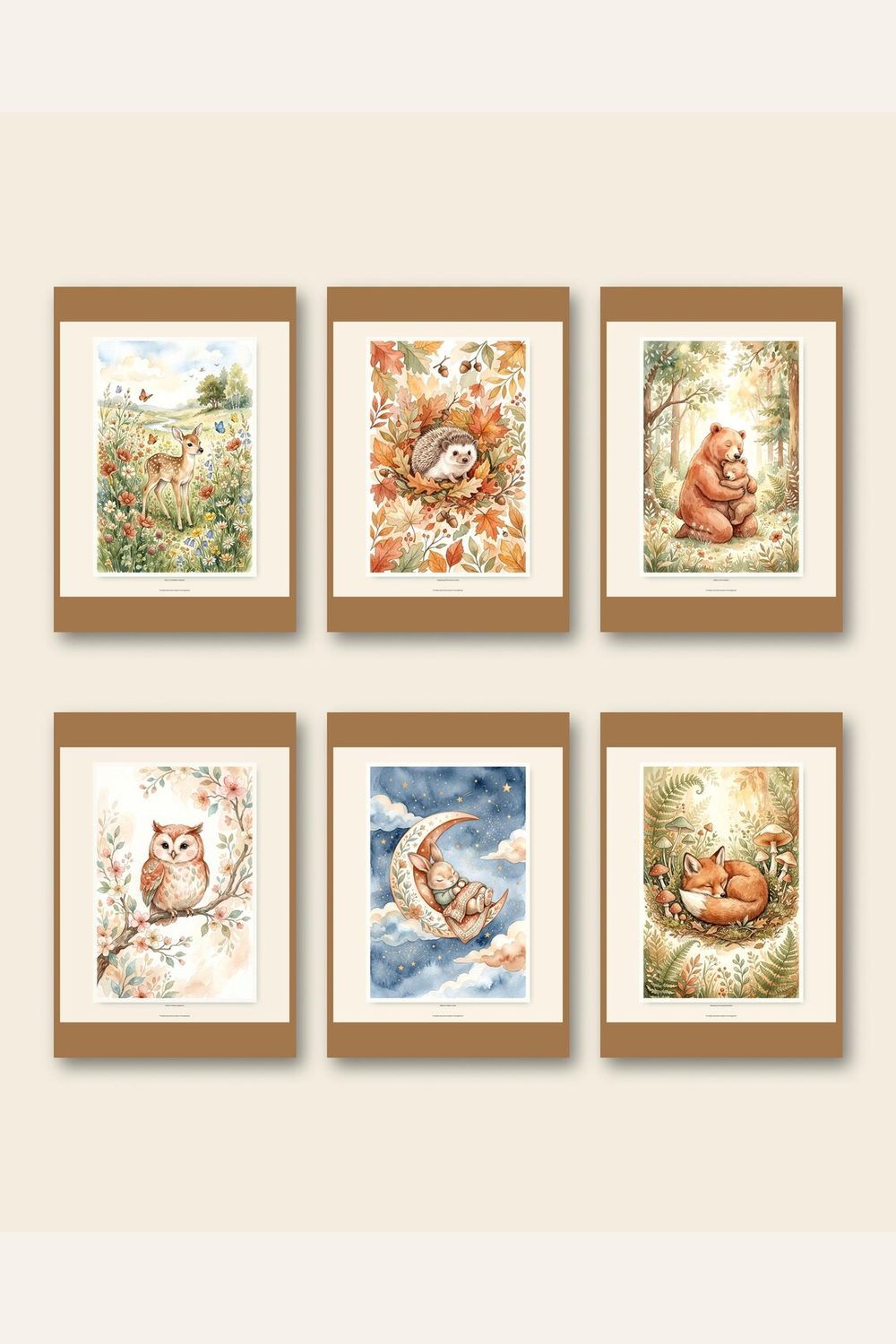
A woodland nursery can feel gentle and story-rich without turning every surface into a forest theme. Watercolor animals provide recognizable characters—a sleeping fox, bears, an owl, deer, a hedgehog, and a rabbit—while the pale backgrounds and natural colors leave room for the nursery to breathe. A coordinated set of six prints is especially useful when one small picture would disappear on a broad wall but a large single poster would feel too dominant.
The best gallery is planned around the room’s real routines. Before choosing frame sizes, watch where doors open, where an adult stands while carrying a baby, how daylight crosses the wall, and which furniture may move as the child grows. Art should add a calm focal point while staying outside a child’s reach. This guide focuses on layout and styling rather than treating the pictures as safety equipment; always follow current crib, furniture, hanging-hardware, and child-safety guidance.
Start with a safe, useful wall
A reading corner, an open wall opposite the crib, or a wall above low closed storage can offer a natural visual anchor. Keep framed art away from the crib and changing surface, and do not place it where a child could reach it now or after furniture changes. Avoid relying on lightweight frames or adhesive strips as proof that a placement is safe. Use wall-appropriate hardware, follow its rated instructions, and reassess the room as climbing and reaching abilities change.
Cut six paper rectangles at the intended outer frame size and tape them temporarily to the wall. View the arrangement from the doorway, the feeding chair, and floor level. Open closet and room doors, operate window coverings, and carry a laundry basket through the traffic path. The test should reveal awkward collisions, glare, and whether the complete group relates to nearby furniture rather than floating too high.
Choose a six-print layout that suits the room
The quiet two-by-three grid
A two-by-three grid gives six different animals a shared rhythm. It works on a wide wall above a low dresser or book cabinet, provided the entire group remains outside a child’s reach and is installed correctly. Keep horizontal and vertical gaps equal. Center the complete gallery on the furniture beneath it, not necessarily on the wall, so the two elements read as one intentional zone.
The woodland story stack
Three rows of two work on a narrow wall beside a reading chair or near a nursery entrance. Put softer, lighter scenes toward the top and visually denser scenes lower down, then step back to check that neither side feels heavy. This vertical arrangement can make a low-ceiling room feel taller, but it still needs clear space above and below rather than stretching from baseboard to ceiling.
Two companion trios
Two horizontal groups of three can connect a reading area and a closed-storage area without filling the wall between them. Repeat the same frame finish, mat color, and spacing so the groups remain related. Another option is one trio above each of two matching shelves, but only where shelf contents and frame placement remain safely inaccessible to a child.
Give every animal a role in the composition
Lay all six designs on a table before assigning positions. Alternate close-up subjects with scenes that contain more landscape or open background. Avoid putting the darkest two images in one corner. If one print has a strong directional gaze or branch, point it toward the center of the group when possible; inward-facing subjects help the eye circulate through the collection.
A simple sequence can also create a bedtime-story feeling. Begin with the fox or rabbit, move through meadow and branch scenes, place the bear pair near the visual center, and finish with a quieter moonlit or autumn subject. There is no required order—the aim is to make neighboring shapes and values feel balanced. Photograph two or three tabletop arrangements in black and white; the grayscale view makes uneven dark areas easier to spot.
Build a soft forest palette without over-theming
Watercolor woodland art pairs naturally with warm white, oatmeal, mushroom, muted sage, dusty blue, soft clay, and natural wood. Choose one neutral base, one muted color, and a small darker accent. For example, warm white walls, sage curtains, and walnut frames create depth while leaving the animals as the narrative focus. In a brighter room, pale oak frames and an oatmeal rug can keep the overall effect airy.
Repeat colors through useful objects rather than buying many animal-shaped decorations. A washable cotton curtain can echo sage foliage; a storage basket can repeat the frame’s wood tone; one clay-colored cushion can pick up autumn leaves. Keeping large surfaces quiet helps the individual watercolor details remain readable and makes it easier to update the room later without replacing the gallery.
Select frames and mats for a cohesive set
Using one frame finish across all six prints is the simplest way to unify different animals. Pale oak or maple suits Scandinavian and neutral nurseries. Medium walnut adds storybook warmth. Slim white frames nearly disappear on warm-white walls, while muted brass or dark bronze can add a traditional touch. Avoid mixing many profiles and finishes unless the rest of the room already has an intentionally collected style.
A warm-white mat gives delicate watercolor edges breathing room and can make several smaller prints read as a substantial gallery. Check the mat opening against the chosen image ratio before ordering. Acrylic glazing may be lighter than glass, but material choice does not replace secure, appropriate installation. Matte or low-reflection surfaces can reduce glare near a window or lamp; test one framed proof in daytime and evening light before buying six.
Choose size from the whole gallery footprint
Measure the available wall, the furniture beneath it, the outer dimensions of each frame, and every gap. Six modest frames can become a large composition once spacing is included. A paper-template test is more reliable than judging dimensions on a shopping screen. Leave clear wall around the outside of the group so it looks framed by the room rather than squeezed between a door casing and ceiling.
Think about normal viewing distance. Small prints can be inviting beside an adult reading chair where details are viewed close up. Across the nursery, a larger size keeps animal silhouettes legible. Select a supplied file that matches the frame or mat opening; never stretch an image into a different ratio. The linked Etsy listing is the source of truth for the currently included file sizes and formats.
Proof color and cropping before printing all six
Print one design first at the intended size on inexpensive paper. Check fur detail, pale backgrounds, leaf edges, and whether neutral shadows remain distinct instead of turning gray or muddy. View the proof in natural light and under the nursery’s evening lamp. Screens are backlit, so a print normally appears less luminous; a physical proof prevents six identical surprises.
Matte or lightly textured art paper often complements watercolor imagery and reduces reflections. Strong texture can soften tiny details, while glossy paper may produce distracting highlights. Printer dialogs often default to “fill,” which can crop edges. Inspect the preview, choose the correct orientation, and print at the intended scale. For practical ratio, paper, and service guidance, use the printable wall art printing guide.
Let the room grow beyond the nursery stage
A forest-animal gallery can move later to a toddler reading room, playroom, hallway, or family cabin-themed corner. Neutral frames make that transition easier. Keep the original digital files backed up according to the listing’s license, label the printed sizes, and store unused mats flat. When furniture changes, repeat the placement and hardware safety review rather than assuming the old arrangement still works.
If the room eventually needs a less character-led direction, compare the soft natural palette in the cottagecore botanical wall art guide. For a broader overview of spacing six-piece collections, visit the printable gallery wall planning guide. After purchase, the digital download help guide covers Etsy file access and common ZIP-download steps.
View the Woodland Nursery Art Set on Etsy
Digital download only. No physical prints, frames, furniture, toys, animals, or nursery accessories are shipped. The linked Etsy listing is the source of truth for current files, sizes, price, license, and availability.
Woodland nursery gallery wall FAQ
Is this a physical set of framed nursery prints?
No. The featured Etsy product is delivered as digital files. You arrange printing and framing; no physical item is mailed.
Where should nursery wall art be placed?
Choose a wall outside the crib and changing area where frames cannot be reached or knocked down. Account for doors, window coverings, future furniture positions, and a child’s increasing reach. Follow current manufacturer instructions and local child-safety guidance.
What layout works for six forest-animal prints?
A two-by-three grid suits a broad wall, three rows of two suit a narrow reading corner, and two coordinated trios can connect separate zones. Keep gaps consistent and balance light and dark scenes across the composition.
How do I keep a woodland nursery from feeling too themed?
Let the prints provide most of the animal imagery. Repeat only a few natural colors in functional textiles and storage, choose one frame finish, and preserve open wall space around the gallery.